Programs & training pathways

The right class starts with the dancer.

We welcome young dancers ages 3 and up. Placement is thoughtfully based on each student’s age, experience, readiness, goals, and schedule—with teacher guidance before enrollment.

Book a Free Placement

Our Dance Styles

Rooted in Chinese dance.
Inspired by multiple styles.

Our dance studio offers a variety of classes for dancers ages 3 and up, at all skill levels.

  • Chinese Dance

  • Ballet

  • Jazz

  • Contemporary

  • K-pop

  • Acro Dance

Chinese Dance is at the heart of our training and choreography. We also incorporate elements of Ballet, Jazz, Contemporary, K-pop, and Acro to create a broader and more dynamic learning experience.

By blending different movement styles with the foundation and expression of Chinese dance, our choreography is designed to connect with today’s young dancers while developing technique, musicality, versatility, and stage presence.

01
Ages 3+ · Placement required

Level-Based Group Classes

Playful, teacher-led movement builds musical awareness, coordination, imitation skills, and spatial awareness while developing classroom habits, confident expression, and teamwork.

What dancers develop

Musical Awareness
Develop a sense of rhythm, tempo, and musical changes, and learn to move along with the music.
Body Coordination
Practice basic movements such as walking, running, jumping, bending, and turning to improve balance and coordination.
Imitation Skills
Strengthen observation and movement understanding through teacher-led imitation and movement games.
Spatial Awareness
Learn concepts such as front and back, left and right, high and low, as well as personal and shared space.
Classroom Habits
Learn to line up, follow instructions, take turns, and complete simple classroom tasks.
Confident Expression
Encourage children to express themselves through movement, facial expressions, and imagination.
Teamwork
Learn interaction, cooperation, and sharing through group activities.
02
Saturday training

Technique & Fundamentals

Focused training develops core strength, body control, endurance, jumping power, foot and ankle strength, turns, musicality, spatial awareness, movement memory, posture, and stage presence.

What dancers develop

Core Strength
Build abdominal and back stability to improve overall body control.
Body Control
Develop stability, precision, and quality of movement.
Muscular Strength & Endurance
Strengthen the legs, ankles, back, and overall body.
Jumping Power & Explosiveness
Improve lower-body strength, ankle stability, explosive power, and control in the air through jumps, landings, and repeated jumping exercises.
Foot & Ankle Strength
Develop stronger feet and ankles, better extension, and greater stability.
Turns & Directional Control
Improve balance, weight placement, and body control during turns and changes of direction.
Rhythm & Musicality
Learn to connect movement with musical timing, dynamics, and expression.
Spatial Awareness
Develop an understanding of direction, distance, formations, and stage space.
Movement Memory
Improve the ability to remember movements, learn combinations, and respond quickly.
Lines & Posture
Develop proper alignment, body extension, and graceful dance lines.
Stage Presence
Build confidence and expression through facial expressions, eye focus, movement quality, and performance skills.
03
Group enrollment required

Competition Solo & Duet

Customized competition choreography brings together music, movement, and stage presentation to highlight each dancer’s age, ability, strengths, and personality. Level Classes and at least 2 hours of weekly training are required.

Customized Competition Choreography

One of the signature features of our competition program is personalized choreography created specifically for our dancers.

Our instructors thoughtfully design each routine based on the dancer’s age, technical level, strengths, personality, musicality, and stage presence, allowing every child to perform with confidence while showcasing their individuality.

From music selection and movement design to formations, transitions, expression, and overall stage presentation, every detail is carefully developed to create a polished and competitive performance.

Rather than using a one-size-fits-all approach, we create choreography that highlights each dancer’s unique strengths and supports continued technical and artistic growth. Our goal is not only to prepare dancers for competition, but also to help them develop their own performance style, confidence, and identity on stage.

04
Announced seasonally

Seasonal Summer Camps

Focused short-term experiences that bring together dance, creativity, cultural exploration, and performance.

Discover Chinese dance

Beautiful in Experience.
Lasting in Growth.

Chinese dance offers children far more than movement. It brings together artistry, physical training, imagination, stage presence, and cultural discovery in a learning experience that is both expressive and deeply enriching.

For many young dancers, the connection begins with something simple and immediate—

  • a flowing skirt opening into a turn,

  • a fan unfolding in their hands,

  • or a piece of music that makes them want to move.

These moments of curiosity often become the beginning of something more.

From interest comes participation.

From participation comes confidence.

And over time, dance becomes a way for children to develop discipline, self-expression, stage presence, and a deeper appreciation for culture.

This is the kind of growth we hope every student carries with them—both on stage and beyond.

01 · Classical tradition

Chinese Classical Dance

Chinese Classical Dance is a mature dance system developed over thousands of years of Chinese culture, drawing inspiration from traditional opera, martial arts, and other classical art forms.

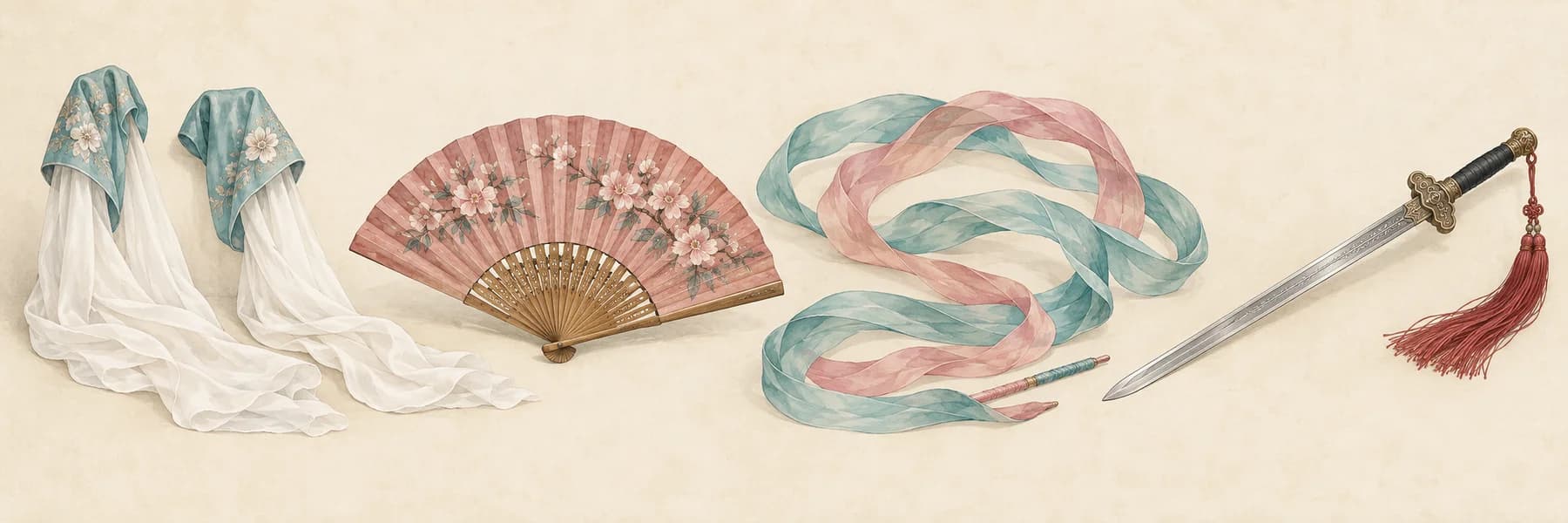
Illustrated water sleeves, an open folding fan, flowing silk ribbons, and a tasselled stage sword, from left to right.
Water sleevesFolding fanLong silk ribbonsStage sword
AI-generated illustration of common stage props.
Core Elements
Emphasizes the integration of hand, eye, body, technique, and form with spirit, strength, and rhythm, while focusing on inner expression, body movement, and breath.
Movement Characteristics
Features refined and expressive movements, with an emphasis on twisting, tilting, circular, and curved body lines, combining both strength and softness.
Common Props
Water sleeves, folding fans, long silk ribbons, and swords are often used to express emotion, character, and historical stories.
02 · Ethnic & folk traditions

Chinese Ethnic & Folk Dance

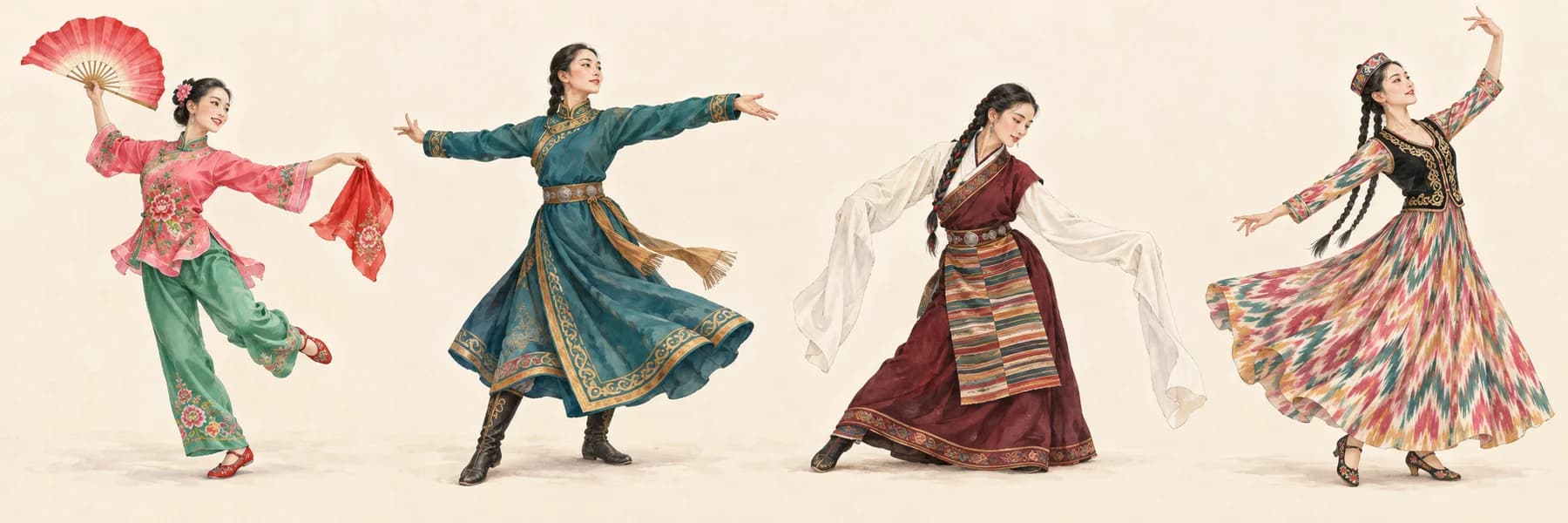
Chinese Ethnic & Folk Dance reflects the traditions, lifestyles, and cultural characteristics of China’s many regions and ethnic groups.

Four illustrated dancers in Han Yangge, Mongolian-inspired, Tibetan-inspired, and Uyghur-inspired stage costumes, from left to right.
Han Folk DanceMongolian DanceTibetan DanceUyghur Dance
AI-generated costume illustrations. Styles vary by region and choreography.

Han Folk Dance

Includes lively styles such as Northeastern Yangge, often featuring expressive handkerchief techniques.

Mongolian Dance

Known for bold and expansive movements, including distinctive shoulder techniques and balancing skills.

Tibetan Dance

Features grounded steps, flowing sleeves, and rhythmic footwork that reflect the spirit of the Tibetan Plateau.

Uyghur Dance

Characterized by an upright posture, expressive head and neck movements, and dynamic turns.

Styles & repertoire

Chinese roots.
A living stage language.

Repertoire rotates by term and is selected for each class's readiness and strengths.

Students may explore Chinese classical dance, Dunhuang-inspired movement, and Chinese ethnic folk traditions such as Tibetan, Mongolian, Uyghur, Korean (Chaoxian), and Dai dance.

For selected performance and competition works, Chinese dance may be thoughtfully combined with Jazz and Contemporary stage language. These are choreography tools—not a promise that every style is offered as a separate weekly class.

Chinese ClassicalEthnic FolkDunhuangLong SilkFan DanceJazz & Contemporary Fusion

How placement works

A thoughtful first step.

Before enrollment, a teacher speaks with the family and recommends the most suitable available class.

  1. 01

    Tell us about your dancer

    Share age, prior experience, goals, preferred language, and availability.

  2. 02

    Speak with a teacher

    We consider readiness and learning needs alongside age and schedule.

  3. 03

    Receive a recommendation

    We suggest the best available Level-Based Group Class and next steps.

Find the right starting point

Every dancer's path begins with a conversation.

Tell us about your dancer's age, experience, goals, and availability. A teacher will help recommend the most suitable current class.

Book a Free Placement
Book a Free PlacementAges 3+ · Teacher-guided